The advent of cheap, mass-produced musical instruments, chiefly fiddles, tin whistles, accordions, mouth organs and concertinas built in German factories, helped the latest dance music to spread from high society ballrooms to the musicians of working class urban, rural and frontier areas, where it thrived. The pace of early ballroom dance is typically relaxed, and hence its music lent itself very well to being played on concertinas as well as on closely related button accordions. The musicians who played these popular free-reed instruments played an oversized role in both the global propagation of early tunes for each new dance style (polka, schottische, etc.) as well as the local composition of new tunes for them. Musicians also drew upon other popular sources for inspiration, including tunes from English music halls and American minstrel shows. More than in any previous era, ballroom dance music was becoming global popular music, while still retaining some measure of local identity.
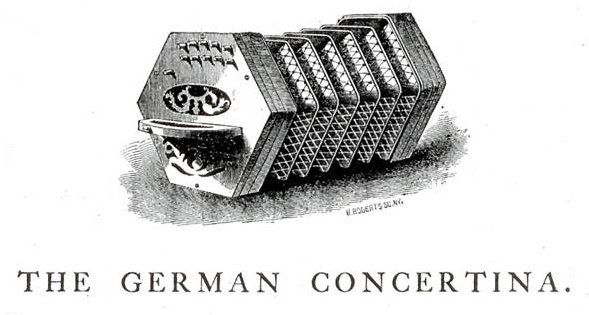
On the continent, the button accordion as well as Chemnitzers and Bandoneons were the free reed instruments most encountered among musicians playing for dances. In Great Britain and its Empire, however, the smaller, typically hexagonal-ended German and Anglo-German ('Anglo') concertina - the focus of this collection - was as popular or more popular than the accordion, especially in the middle to late nineteenth century. In particular, the concertina was a key part of social dances in England, Ireland, Australia, New Zealand, and in Dutch (Boer) portions of South Africa. It was also a popular instrument for dances in Canada and the United States, but to a somewhat lesser extent than were accordions and stringed instruments.
In contrast, in the global folk music revival of the past half century or more, most 'traditional' music is now played for listening in pubs, concert halls, and festivals rather than for dancing, and as a result the Anglo concertina has come to be played at a more rapid tempo and ever more complexly in terms of added ornaments, chords and/or phrasing in Ireland, England and South Africa, displaying a different take on such modernity in each country. As a result, the earlier and nearly universal 'octave' style that was employed for house dances a century and more ago has all but disappeared among most players today. Very few modern concertina players are technically proficient in playing the old manner, nor typically are most skilled in playing for dances; the world of the house dance has long since passed away. Hence, this collection of early recordings provides modern Anglo players a window into a largely forgotten world. Moreover, the close similarity in musical repertoire, dances, and concertina playing techniques across the globe that was so evident during the concertina's heyday is often overlooked today as folk revival musicians strive to mark the musical boundaries of each country's national identity.
This anti-foreign crusade was well underway in the early years of the Irish concertina players whose recordings are presented in this archive. These recordings show a split between those (mostly women) who remembered the repertoire of the earlier house dances and those (mostly men) who cast their musical lot with the céilí dances that were designed by cultural authorities to replace them. As a result of the anti-foreign crusade, by today the traditional music repertoire in Ireland has become decidedly lean in schottisches, barn dances, mazurkas, waltzes, old quadrille tunes and the like relative to that of all other countries where ballroom dance had been popular. Instead, middle twentieth century and later Irish musicians have focused sharply upon the step dance music of the pre-Famine era, notwithstanding the obvious fact that reels, jigs and hornpipes were once equally 'foreign' imports.
Beyond the old-fashioned repertoire and the equally old-fashioned manner in which the concertina was played, there is a refreshing, pretension-free ethos of the musicians themselves that emerges from their playing. In general these were rural people playing in a simple fashion for a shared musical and community purpose. In this music there is none of the rapid-fire and technically ornate virtuosity that is to be found in so many performances of traditional music today, and little to none of the constant strumming of guitars or drums as accompaniment in commercial performances; rather, this was the era of solo instrumentalists playing for dancers. There were no competitions to inject complexity into the melodies, nor, one might imagine, would these players be much impressed if there had been. From the unusual and at times eccentric settings of many of the pieces one can get the feeling that aural transmission of tunes from other musicians, not standard settings taken from recordings or tune books, was king. It was the last hurrah for 'traditional' dance music (not that these musicians would have been familiar with that term) in the era when such music and dance was the recreation of the majority in rural communities, rather than of the minority that it has been in most places ever since. It is music worth hearing.
| NEXT |