In Ireland, the only significant, known printed source for the full range of dances that were once danced there in country houses - including schottisches, barn dances, waltzes, mazurkas, quadrilles and the like - is to be found in The Roche Collection of Traditional Irish Music, first published in 1929 and reprinted by Ossian Publications. There are only a few pages there, however, of these dance tunes, which Roche rather ironically put into a section called 'Old Dances' to separate them from the more numerous reels and jigs. Irish polkas, most of them of the later form used in set dances, can be found in several printed sources, most notably in the Breathnach's Ceol Rince na hÉireann, volumes 2 and 3 (published by An Gúm, Dublin), and in the book Johnny O'Leary of Sliabh Luachra: dance music from the Cork-Kerry border, published in 1994 by The Lilliput Press.
For ear players, there is the extensive digital online archive of Comhaltas Ceoltóirí Éireann. A search on the word schottische, for example, will turn up a number of archived examples from early players on various instruments. The Topic Records CD entitled Round the House and Mind the Dresser: Irish Country-House Dance Music provides a number of early twentieth century recordings of Irish house dance music as well as a commentary on the style's near-disappearance in Ireland. The online Set Dancing News of Bill Lynch documents the return of set dancing in Ireland and abroad, and mentions many social evenings that now often include a schottische, a barndance, or a Shoe the Donkey varsoviana.
In England, ballroom-style dance was (and perhaps still is) viewed unfavorably by many in the folk music community. An article entitled English Country Music - A Personal View by Roger Digby, to be found on the website: www.concertina.net, lists many old-time traditional groups who played, and in some cases still play, this music. The Topic CD of 2000 entitled English Country Music has many examples of this dance music played by stalwarts of the genre (including Scan Tester), and comes with an informative booklet by Reg Hall. Perhaps the most significant British commentary on the topic is to be found in Chapter 5 of the book I Never Played to Many Posh Dances, which is a celebration of the life and times of Scan Tester written by Reg Hall, published in 1990 by Musical Traditions and now available for free download on their online website: www.mustrad.org.uk/articles/r_hall.htm
In South Africa, the two main boeremusiek societies, the Tradisionele Boeremusiekklub van Suid-Afrika (TBK) and the Boeremusiekgilde, both operate websites with much information on the topic, and both can provide many CDs of early performers as well as their modern counterparts. There is however not a lot of printed music. A key reference on the history of boeremusiek and its dances (in Afrikaans) is Wilhelm Schultz's Die Ontstaan en Ontwikkeling van Boeremusiek, published in 2001 by A.V.A. Systems in Pretoria.
Australia has a rich array of both printed music and audio files of pre-folk revival musicians. The National Library of Australia is the principal site for sound files of early players, and the two books of John Meredith that they published are primary references on bush music and musicians. The Bush Dance & Music Club of Bendigo & District has compiled a large number of finely detailed publications, many of them by concertina player and dance master Peter Ellis, that contain many hundreds of dance tunes as well as comprehensive instructions on how to do the dances themselves. Because the tunes of ballroom dance are often of global origin, these are important if not essential resources for all (in particular, Ellis's The Waltz, the Polka, and all Kinds of Dance Music (2007) as well as his The Merrie Country Dance (2005)). There are a number of other societies that provide information on colonial and bush dancing, among them the Bush Music Club of Sydney, the Wongawilli Colonial Dance Club, Bush Traditions, and the Australian Folklore Unit.
A retired geologist, he has played the concertina for nearly 40 years, and has focused on the various styles employed by pre-folk revival concertina players around the world. He has played for contra and English country dances in his area, and helps organize an annual concertina workshop at the Palestine Texas Old-Time Music Festival. He and his wife live on a small farm in the Brazos River valley of coastal Texas.
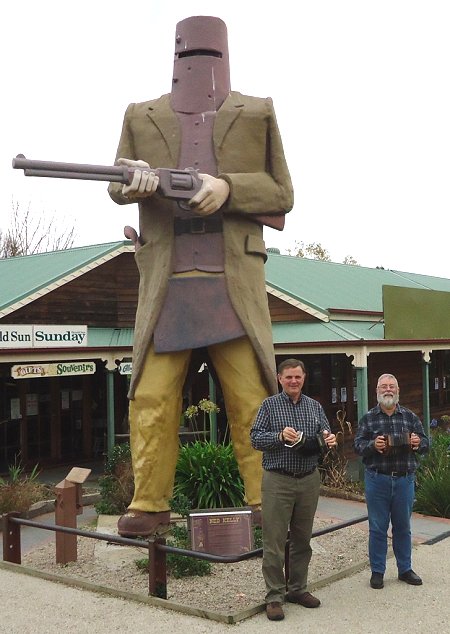
Dan Worrall (left) and Peter Ellis serenade the statue of Australian folk icon
Ned Kelly in Glenrowan, Victoria, 2011. The song, The Ballad of Ned Kelly,
is sung by concertina player George Bennett in Chapter 7.
| NEXT |